Harry Jones’s murder by cyanide
The Big SleepHarry Jones’s murder by cyanide is the turning point in Philip Marlowe’s effort to locate Agnes Lozelle: under pressure from Lash Canino, Jones reveals her address, then dies after accepting a drink from him. The scene makes Jones’s apparent surrender difficult to read as simple betrayal. Marlowe concludes that Jones deceived Canino before his death, and treats the small-time informant’s choice as an act of loyalty rather than cowardice.
Background and Stakes
Marlowe is trying to find Agnes, whose information could help him understand the illicit business connected to Arthur Gwynn Geiger. Canino, a violent operative associated with Eddie Mars, is also seeking her. The confrontation therefore centers on a piece of practical information—the location of Agnes—and on who will control what she can reveal.
The exchange takes place in a room where Marlowe can hear the men but does not immediately intervene. Canino puts a gun before Jones and asks where Agnes is. Jones answers that she is in Apartment 301 at 28 Court Street, on Bunker Hill. He explains his decision by asking why he should continue to protect the woman, whom he dismisses as having used him. His admission gives Canino the address, but it does not settle whether Jones has told the whole truth.
The Poisoning
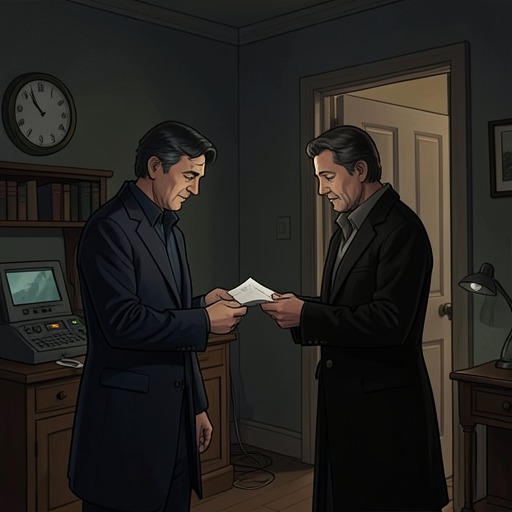
After Jones names the apartment, Canino drops his threatening manner and proposes that they go together to see Agnes. He reassures Jones that there are no hard feelings, then offers him a drink. Jones accepts. The switch from open intimidation to apparent friendliness makes the drink part of Canino’s method: the immediate danger no longer appears to be the gun, but the invitation to resume ordinary conversation.
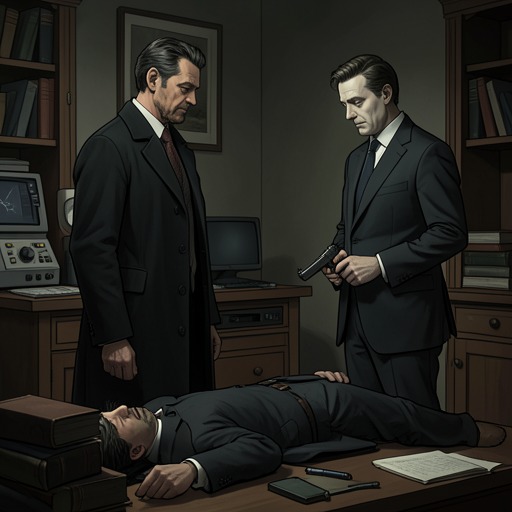
Marlowe hears Jones cough sharply and retch, followed by silence. When he enters, he finds Jones sitting upright in his chair, with a whiskey bottle and a glass on the desk. A second glass is missing. Marlowe detects the odor of bitter almonds behind the bourbon and identifies cyanide as the cause of death. The murder is thus established through what he hears and finds, rather than through a witnessed act of poisoning.
Jones’s Deception and Marlowe’s Response
Marlowe’s interpretation of Jones changes after the killing. Looking at Jones’s body, he tells him that he fooled Canino, lied to him, and drank the cyanide. He distinguishes Jones from the coward Canino’s threat had implied, addressing him as a man who died without being, in Marlowe’s judgment, a rat. The address Jones supplied has led Canino to believe he can reach Agnes, but Marlowe’s words indicate that Jones’s apparent cooperation concealed a further deception. The evidence does not disclose exactly what Jones told Canino beyond the address, so the precise form of the lie remains unspecified.
The recognition comes with a practical consequence: Marlowe knows that Canino may return to the scene. He searches Jones for anything that might help locate Agnes, finds nothing useful, and then must respond to a ringing telephone rather than linger over the death. Jones’s killing has made the search more urgent while leaving Marlowe with no immediate explanation from the man who might have supplied one.
Significance
The scene gives Jones’s brief appearance a moral weight beyond his role as an informant. Canino makes disclosure a condition of survival, and Jones does reveal Agnes’s address; yet Marlowe’s final judgment refuses to equate that disclosure with complete surrender. The tension between the spoken answer and the unspoken deception leaves Jones’s last act partly veiled, fitting a story in which information is bargaining power and apparent explanations can conceal what happened.
The murder also sharpens the contrast between private knowledge and public accounts of violence. Elsewhere, the official handling of the connected crimes is shaped by omissions and a deliberately simplified story; Jones’s death, by contrast, reaches Marlowe through an immediate sequence of threat, drink, sound, and physical evidence. Its significance lies not only in removing a source of information, but in showing the personal cost of trying to protect someone from Canino while navigating a compromised investigation.